
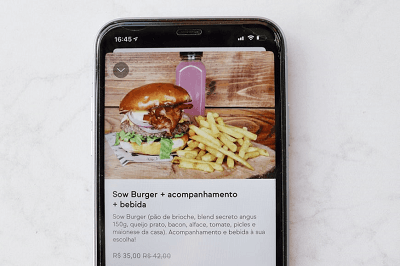


A paper menu will never help your guests to read your menus, nor will it allow you to create discount offers for them. But with a digital menu, your brand will surely be seen online where customers would want to order food or drinks. Studies show that a digital menu is expected to give customers a great impression of a restaurant. Even if a customer doesn't book a table at first, his attitude can very well change after viewing a restaurant's digital menu.
What is a digital menu and why would you want to make the switch?
We all order food from more than 100 different places a month, and we don't think about ordering food much. We do it automatically, without thinking about it. But restaurants have a choice: they can either force customers to order food the same way each time, or they can let customers order any way they want. The traditional approach is to make customers order the same each time, with preset options for as many menu items as the restaurant has. For example, if a restaurant has 10 different entrees, it will have 10 preset options: chicken, steak, salmon, and so on. Customers order from these options instead of choosing from the menu. The digital menu lets customers order any way they want. On a digital menu, customers select menu items from a list of names. The menu might have 100 names of entrees, or 10 names. Instead of giving customers a menu with preset options, the menu is like a phone book: customers can name what they want. Have you ever seen a menu that lists names that are written in different sizes? The names are bigger for entrees than for side dishes. The menu also might list entrees in categories: for example, "hot and cold," "meat," "seafood," or "daytime." The digital menu lets customers order either by clicking a preset option or by typing a name. The menu will know what entree or side dish a customer is looking for: when a customer orders "chicken," the menu will show a list of entrees starting with "chicken." When a customer searches "corn chowder," the menu will show a list of entrees starting with "corn chowder."
A few reasons why digital menus are becoming more and more popular
When the Internet came along, it did not take long for restaurants to start using it. At first, just listing a couple of items on the menu, then adding pictures and prices, was enough. Now some restaurants offer hundreds of items online and that number is growing constantly. At first, restaurants had no way of knowing whether customers would actually order something from their online menus. But by 2010, ordering from websites had become much more common. Now, many restaurants are starting to offer their menus on tablets or other devices. These new digital menus are cheap, attractive, and fast, and they support customers who are in a hurry. A digital menu has many advantages. It is easier to read from a distance; it is easier to read from a wheelchair or a table; it is easier to read in poor light. A digital menu is cheaper to produce, so restaurants can charge less for it; it is easy to update, so you can change prices or ingredients whenever you wish.
A breakdown of the three main types of digital menus: Online based, App based and browser based.
A digital menu allows you to display detailed menu information and pictures. It saves space, costs less, and enhances your brand. Today, digital menus are finding their way into quick service restaurants, casual dining restaurants, hospitals, stadiums, and casinos. Digital menus allow customers to see a detailed menu before ordering. They can also view nutrition information, allergy information, special offers, and dessert menus. Digital menus allow customers to order and pay with a touch-screen device such as a table. There are three main types of digital menus: online-based, app-based, and browser-based. Online-based An online-based digital menu is a website that a customer visits for ordering. The website allows the customer to see the entire menu, offers, and nutritional information. The website also allows the customer to place an order and pay with their credit or debit card. App-based An app-based digital menu is an app that a customer downloads on their smartphone or table device. The app allows the customer to see the entire menu and offers. The app also allows the customer to place an order and pay with their credit or debit card. Browser-based A browser-based digital menu is a website that a customer visits on their laptop or desktop computer. The website allows the customer to see the entire menu, offers, and nutritional information. The website also allows the customer to place an order and pay with their credit or debit card.
Digital menus are better for the environment
Ever since the invention of digital menus, restaurants have been causing less waste. When paper menus first came out, they were printed on large sheets. People would tear off what they needed, then throw them away. By that time, the printing press had made paper cheap, but paper was still too valuable to waste. So it made sense for restaurants to waste as little paper as possible. Digital menus are less wasteful than paper because restaurants can now make every menu page individually, as needed.
Digital menus have many advantages for restaurants. On a computer, a restaurant's menu can be updated at any time. If a customer asks for something that's not on the menu, the restaurant can still put it on. If a new dish is added, customers know about it right away. Digital menus also make it easier for restaurants to get help from their customers. If a customer has a favorite dish, he or she can tell the restaurant about it, and the restaurant can add it to the menu. You can easily manage your digital menu at Orda